If you’re wondering how to keep dogs away from your cat’s litter box, you’re not alone—this is one of the most common problems in multi-pet homes.
You’ve probably encountered that moment: you walk in and find the dog sniffing, pawing, or even eating your cat’s litter. It’s annoying, unsanitary, and can stress the cat — something many new owners discover early on when they first bring home a kitten, often after searching through local cat breeders or shelters. But the real issue isn’t just curiosity — it’s rooted in canine behaviour and unmet needs. Understanding the why lets you build solutions that last.
We’ll go beyond basic traps and gates to explore real behavioural drivers, comparative animal cognition, and tested strategies that professional behaviourists and multi‑species households swear by.
Table of Contents
Why Dogs Go for the Litter box (It’s Not Just Gross Curiosity)
People assume dogs “should know better,” but dogs explore the world with their noses, mouths, and instincts, or even eat the litter. Several factors explain the dog’s interest in cat litter:
1. Instinctive scavenging
Dogs are opportunistic feeders. In ancestral environments, carnivores frequently consumed others’ waste simply because it contains undigested nutrients and salts. This isn’t just dumb taste — it’s rooted in evolutionary drives. Some dog breeds (e.g., hound breeds, terriers) show stronger scavenging instincts than others.
2. Nutrition or digestive imbalance
A dog eating cat feces (coprophagia) often signals a dietary or gut imbalance. Commercial cat food is higher in protein and fat than dog food; partially undigested bits in feces can be highly appealing to a dog’s nutrient‑seeking senses.
3. Boredom and stimulation seeking
For many dogs, the litterbox becomes an “activity object” — something that moves, smells, and invites interaction. Dogs with inadequate mental or physical exercise often discover litterbox play as self‑directed enrichment.
4. Scent curiosity and social information‑gathering
Canines process social information from feces and urine — the same reason dogs sniff each other’s behinds. A cat’s litter smells like a highly concentrated social signal, so sniffing and investigating is behaviourally normal.
5. Conflict or resource guarding in cats
Cats may respond by guarding the box, hiding, or avoiding it — which can trigger stress markers (e.g., inappropriate elimination elsewhere). To resolve the litterbox problem holistically, you also have to address the cat’s psychological response.
Typical Scenarios (and Why Simple Barriers Often Fail)
Before jumping to solutions, let’s look at some real patterns people face. Behaviourists see these themes again and again:
Scenario 1: “The Sneaky”
A dog that quietly walks by, sniffs the litter, and bolts. The owner shouts, “No!” but the dog returns later.
Underlying drivers: Curiosity + intermittent reinforcement. Every so often, the dog does find something interesting, so the behaviour sticks.
Why scolding fails: Dogs don’t connect the scolding to the specific behaviour unless it’s immediate and paired with a clear alternative behaviour.
Scenario 2: “The Persistent”
A dog that repeatedly dips a paw or mouth into the box despite barriers.
Underlying drivers: Understimulation + scent reward. Some dogs are food-driven by design; the high protein in cat feces can act like a target scent.
Why many barriers fail: If the dog’s motivation (food/scents) outweighs the perceived barrier difficulty, they’ll find or create gaps.
Scenario 3: “The Observer”
A dog that doesn’t touch the box with people around, but does when left alone.
Underlying drivers: Attention‑seeking + boredom. The dog has learned that while alone, investigating the box gives stimulation.
Why this is subtle: Many owners only see the aftermath, not the cause, which may be insufficient enrichment when alone.
In each case, it’s not just “bad behaviour” — it’s functional behaviour that meets a need. Addressing the function is key.
Behavioural Solutions That Work
Rather than focus on “keep away!” as a punishment, think in terms of redirect, replace, and restructure.
1. Make the litterbox less interesting without compromising your cat’s comfort
Swap litter type or maintenance schedule
Some litter types (especially scented or clumping litter with strong smells) are more attractive to dogs. Experiment with:
- Unscented, fine‑grain litter — less interesting to sniff and paw.
- More frequent cleaning — reduces residual scent cues dogs follow.
- Fully enclosed boxes (see next section).
Do not permanently hide a cat’s resources; half‑solutions can stress cats and create territorial behaviour.
2. Physical restructuring that respects both pets
High placement
Cats can jump; most dogs cannot. Putting the litterbox on a counter, shelf, or cat tree platform out of canine reach often solves the problem with minimal conflict.
Cat‑only entry points
Install a baby gate with a cat‑door cutout (a small pet door in a barrier). Cats slip through, dogs don’t.
Selective doors/microchip doors
Microchip‑activated cat doors that only open when your cat approaches are ideal if the box is in a room like a laundry or bathroom. This gives your cat privacy while keeping dogs out.
Enclosed boxes with feline entry only
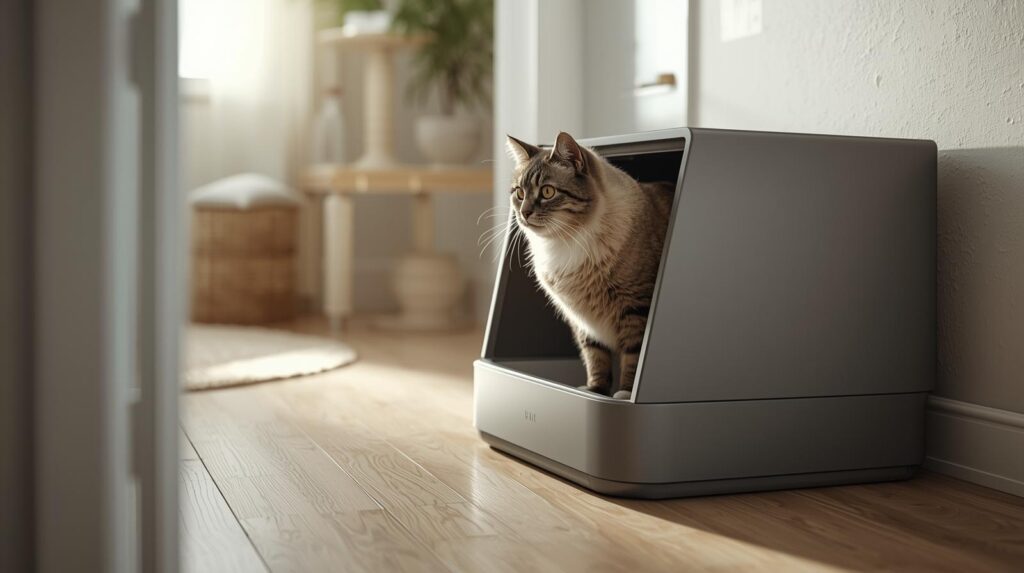
Boxes with small entrances at cat height — especially horizontal entrances — can deter most dogs. Consider hard‑covered high‑sided boxes with cat access holes.
3. Redirect & replace the motivation
If the dog is drawn by scent or boredom, address that directly:
Scent alternatives
Give dogs their own “sniff station” toy or foraging mat with safe scents (e.g., rosemary, orange peel). These provide scent stimulation that doesn’t involve litter.
Food puzzle feeders before the scheduled litter use times
Timed puzzles or treat balls before your cat’s usual box time keep the dog busy and less interested in litter.
Interactive exercise before the cat box windows
A 10‑minute walk or play session reduces the dog’s overall drive to explore everything in the house.
Training Approaches That Work
Teach a solid “Leave It” and “Go to Place.”
This empowers clear communication:
- Train “Leave it” with high‑value reinforcement until the dog reliably disengages from low‑value objects.
- Pair this with “Go to Place” (bed/mat) — a safe spot the dog can go when the cat is headed to the box.
Both cues give you and the dog a predictable system rather than reactive shouting.
Bonus tip:
When the dog does anything but approach the litterbox during a cue window, immediately reward. This positive reinforcement builds the behaviour you want (staying away), rather than punishing curiosity and increasing stress.
Health & Safety Concerns
Letting dogs access cat litter isn’t just unpleasant; it poses real risks:
1. Parasite transmission
Cat feces can contain Toxoplasma gondii oocysts — a serious parasite that dogs can carry and spread if not properly managed.
2. Bacterial exposure
E. coli and other enteric pathogens can transfer from cat feces to dogs and vice versa. Frequent dog sniffing or licking increases the risk of infection.
3. Dietary imbalance & choking hazards
Some litters (especially clumping clay) can expand in a dog’s digestive tract, posing an obstruction risk.
Given these, preventive measures are not optional for health‑conscious homes.
Environmental Management
Here’s what many experienced multi‑species pet owners do:
Place the litterbox in a dedicated “cat room.”
A laundry room or bathroom with a dog‑proof doorway often solves the issue permanently.
Multiple litterboxes
Place additional boxes in dog‑inaccessible areas. Cats like choice; this reduces anxiety if one box is compromised.
Scheduled cleaning routine
Cleaner boxes = less attractive to dogs. Frequent scooping reduces residual scents that entice canine investigation.
Enrichment rotation for dogs
Alternating puzzle feeders, scent work games, and chew toys keep dogs engaged. An unstimulated dog is a bored dog, and bored dogs find trouble.
When Nothing Seems to Work
If your dog continues to pursue the litter box despite barriers and training, consider a professional behavior consultation. Sometimes the underlying drive is:
- Anxiety
- Obsessive scanning behaviour
- Unmet foraging instincts
- Medical issues (e.g., nutrient deficits)
A behaviourist can assess context cues you might miss (e.g., timing patterns, unseen triggers, inadvertent reinforcement loops).
Build a System, Not Just a Barrier
Keeping dogs away from your cat’s litter box isn’t just about blocking access. It’s about understanding why dogs are interested, what needs they’re meeting, and how to restructure their environment and routines so that both pets feel safe and satisfied.
Cats need privacy, security, and routine. Dogs need stimulation, scent outlets, and clear communication. When you tailor your home to both species’ behavioural needs, peace becomes the norm instead of the exception.
Frequently Asked Questions
Why do dogs eat cat litter or cat poop?
Dogs are instinctive scavengers. Cat feces often contain undigested protein and fat from cat food, which makes it smell appealing to dogs. In some cases, this behavior can also be linked to boredom, lack of mental stimulation, or dietary imbalances.
Is it dangerous for dogs to eat cat litter?
Yes. Eating cat litter can expose dogs to parasites such as Toxoplasma gondii, harmful bacteria, and choking or intestinal blockage risks—especially with clumping clay litter, which can expand in the digestive tract.
Will a covered litter box keep dogs away?
Sometimes, but not always. Many dogs can still reach into standard covered litter boxes. Boxes with cat-only entry points, top-entry designs, or elevated placement are far more effective at keeping dogs out while maintaining cat comfort.
What is the best way to keep dogs out of the litter box?
The most reliable approach combines:
Physical barriers (cat-only rooms, elevated boxes, or microchip doors)
Environmental enrichment for dogs (exercise, puzzle feeders)
Consistent training using commands like “Leave it” and “Go to place.”
No single solution works for every household, but layered strategies are the most effective.
Can training alone stop a dog from going into the litter box?
Training helps, but it rarely works on its own. Dogs are strongly motivated by scent and food rewards. Training should be paired with environmental management to prevent access while reinforcing appropriate behavior.
Are certain dog breeds more likely to go after cat litter?
Yes. Breeds with strong scavenging or scent-driven instincts—such as hounds, terriers, and some working breeds—are more likely to investigate litter boxes. However, any dog can develop this habit if bored or under-stimulated.