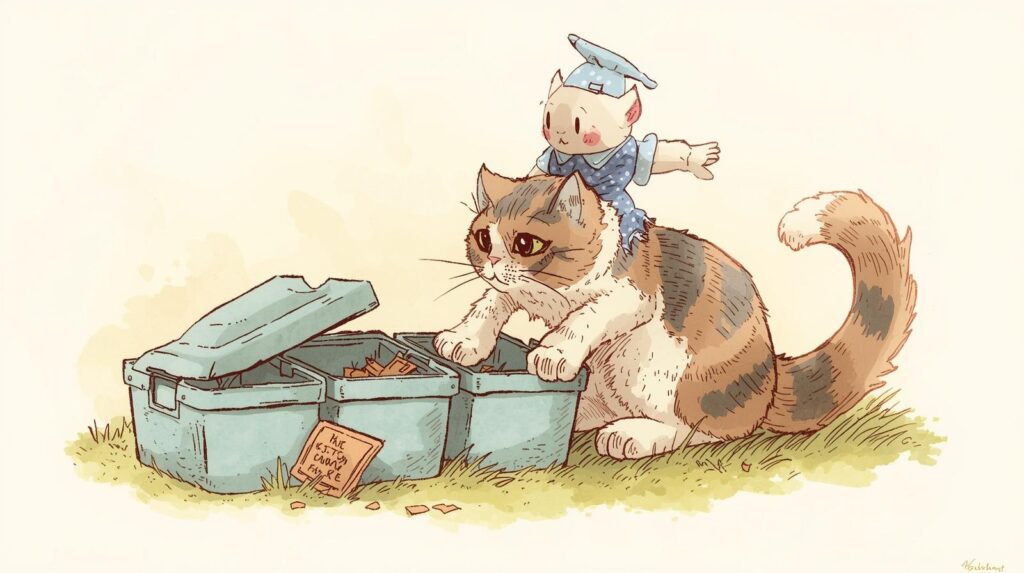
In the first few days after your cat dies, the hardest part isn’t always how quiet the house has become. Sometimes, it’s all the little things still sitting exactly where they were.
The blanket on the windowsill where your cat liked to sleep in the sun. The little stuffed mouse they batted under the sofa. The scratching board in the corner, worn down to almost nothing. The half-finished bag of cat food in the kitchen.
Even the litter box is still there, in the same spot where it stood yesterday, and the day before that.
You used to think some of these things were a nuisance. The fur that never seemed to come off the furniture. The toys scattered across the floor. The sound of digging in the litter box waking you up in the middle of the night.
Now there is nothing to clean up, and somehow that feels worse.
Someone who loves you might gently say, “Why don’t you put their things away? Seeing them every day will only make you sadder.”
They mean well. But anyone who has loved a cat knows that picking up their belongings and putting them in a trash bag isn’t a small chore.
Especially that old bed, the one that’s lost its shape and probably should have been replaced years ago. You know your cat won’t come back to sleep in it. Still, you can’t quite bring yourself to move it.
Because those aren’t just pet supplies. They’re proof of a life that was lived in your home, right alongside yours.
So, should you keep your cat’s things or throw them away?
There isn’t one right answer. And you don’t have to decide today.
Table of Contents
1. In the First Few Days, It’s Okay to Leave Everything Where It Is
When the loss is still so fresh, you don’t need to force yourself to tidy the house or pack everything into boxes.
Let the bed stay where it is. Leave the little blanket by the window. If the feather wand is still beside the sofa, it can stay there too.
There’s a concept in grief psychology called continuing bonds. It simply means that losing someone you love doesn’t mean you have to cut every connection to them. For some people, keeping a familiar object nearby offers a little comfort while they learn to live with the loss.
Maybe you still look toward the spot where your cat used to nap, without even thinking about it.
Maybe you wake up and reach toward the foot of the bed, expecting to feel a small, warm body curled up there.
Or you catch yourself stepping around the place where their food bowl used to be, even though there’s nothing in your way anymore.
Habits like these don’t disappear the moment your cat is gone. They were part of your ordinary days for so long.
If the thought of seeing that corner empty is too much right now, don’t empty it.
There is no rule that says a cat’s belongings must be cleared away within a few days, or a few weeks, or by any particular date. You are allowed to have a little more time.
2. When You’re Ready, Keep the Things That Mean the Most
One day, you may feel ready to pick up a few things and look at them properly.
Not because you have to decide what to throw away. Just because you want to remember.
It might be that stuffed mouse with a bit of stuffing poking out. Or the feather wand with hardly any feathers left, the one your cat would still chase as though it were brand-new.
Maybe it’s the collar they wore as a kitten. Maybe it’s a little tuft of fur you saved after brushing them.
To someone else, these things might look old, broken, or ordinary. But you can still picture exactly how your cat played with them. You know the memories they carry.
Try choosing just a few pieces you can’t bear to part with. Put them in a small box, if that feels right.
It doesn’t have to be a special memory box from a shop. An ordinary box in a drawer can hold something precious. You might keep it on a bookshelf, or put it somewhere private and take it out whenever you miss your cat.
Some people like to make a quiet little space at home, with a favorite photograph and a toy their cat loved. Others would rather keep those things out of sight for now. Both are okay.
If your cat was cremated and you want to keep their ashes close, that space can hold them too. Some people choose a simple wooden box; others prefer personalized cat urns made from photographs, so they can still see the familiar face they loved.
It doesn’t need to be an elaborate memorial. It doesn’t have to look a certain way, and you don’t have to keep everything.
Sometimes one small thing is enough to bring back a whole afternoon together.
3. Food, Litter Boxes, and Cat Trees: Take Care of the Practical Things Slowly
Some belongings can stay with you for years. Others are everyday supplies, and eventually you’ll need to work out what to do with them.
Maybe there’s an unopened bag of food in the cupboard. Maybe you bought a new bag of litter just last week, or there’s a litter box your cat barely used.
If the items are clean, properly stored, and safe to pass on, you could ask a friend who has cats whether they need them. You could also contact a local rescue to ask what supplies they accept.
But there is one important exception.
If your cat died from a contagious illness, such as feline panleukopenia, don’t give away their bedding, toys, food bowls, leftover food, or other belongings without checking what is safe first. Some infectious agents can remain in the environment for a long time, and an ordinary wash may not be enough.
Ask your veterinarian what can be safely disinfected and what should be thrown away. It’s a small but important way to protect another cat.
And then there’s the cat tree. The big one taking up half the living room, the one you used to complain about because it was always in the way.
If looking at it makes your chest tighten, you don’t have to keep staring at it. You can take it apart and put it in storage. You don’t have to donate it today, and you don’t have to throw it out either.
There may come a day when you’re glad to pass it on to another cat. Or there may not. You can decide later.
The litter box can be surprisingly hard to face, too.
Scooping litter was probably never your favorite job. Yet when there are no new clumps to scoop, you might find yourself missing even that ordinary part of the day.
If cleaning it out feels unbearable, ask someone you trust to help. You don’t have to do every difficult thing by yourself.
If your cat was cremated, there’s also the question of their ashes. Some people want to keep them at home. Some hope to scatter them somewhere meaningful. Some simply aren’t ready to choose. If you’re unsure, it may help to read about the different ways to keep or handle your pet’s ashes after cremation before deciding what feels right for you.
None of these decisions has to be made on the same day.
4. Keeping Their Things Doesn’t Mean You Can’t Let Go
Some people don’t understand why an old food bowl or a blanket covered in cat hair can be so hard to part with.
It’s only a bowl, they might think. You could buy another one for a few dollars.
But you know it isn’t really about the bowl.
It’s about the way your cat sat by the kitchen door every morning, waiting for breakfast. The warm weight of them curled against you on a cold night. The way they would hear your key in the lock and come walking over, slowly and sleepily, as if they’d only just woken up.
They were there for all those little moments. They were part of how home felt.
And now that they’re gone, the things they’ve left behind seem to say something you desperately need to hear:
They were really here.
They ate here. They slept here. They chased toys down the hallway, made a mess, demanded your attention, and sometimes acted as though the entire house belonged to them.
And they were loved here.
You don’t need to make yourself “move on” before you’re ready.
If you want to keep their favorite blanket, keep it. If, someday, you give their cat tree to a rescue or another cat who needs it, that doesn’t mean you miss them any less.
You can wash their old bowl and put it carefully in a cupboard.
You can leave that little stuffed mouse on the windowsill, where it always seemed to end up.
And when the day comes that you can put more things away, you may still cry. That’s okay, too.
Putting your cat’s belongings away doesn’t mean you’re erasing them from your life.
After all, what stays with you was never just the blanket, or the bowl, or the toy.
It’s all the days you got to share.